
Refrigeration, Ice and HVAC Service for Convenience Stores
Coolers, ice and the air conditioning — the three things a store cannot trade without.
Book a Service Call (678) 778-6648
- 20 yearsOwner’s time in the trade
- Snellville, GAGwinnett County and nearby
- Refrigeration & HVACPlus HVAC
A convenience store is mostly refrigeration with a building around it: reach-in door coolers, beverage cases, ice machines and the HVAC keeping the space workable. When a cooler drifts above 41°F your stock is at risk, and when the ice machine slows in summer your busiest category stops selling. Most of it traces back to condenser coils, door gaskets and water quality rather than to anything dramatic.
What we keep running in a store
-
Reach-in and door coolers
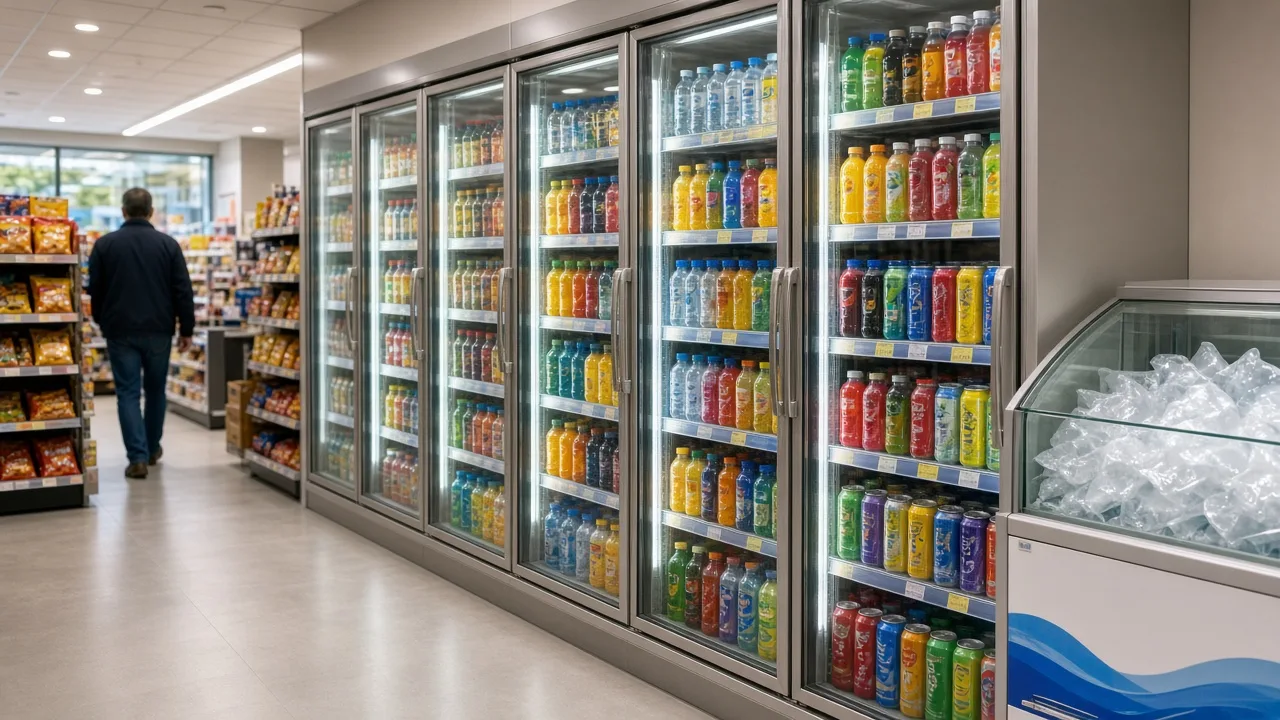
The wall of glass doors that is opened hundreds of times a day.
-
Beverage and open cases
Units working hardest in the warmest part of the store.
-
Ice machines
Production, scale, sanitation and water quality — usually the first thing to fade in summer.
-
Store HVAC
Rooftop and split systems keeping ambient in a range the coolers can work against.
What usually goes wrong
These show up gradually, and your ice machine is normally the first thing to tell you something is wrong.
- Door coolers not recovering between busy periods
- Ice output dropping off, or cubes coming out cloudy, soft or hollow
- Condensation or frost building up on door frames and gaskets
- A cooler that runs constantly without reaching its set point
- Store temperature climbing, which makes every cooler work harder
- Water pooling under a case or around the ice machine
A convenience store is a compact, high-uptime retail business whose stock sits behind glass. Beverage walls, reach-in door coolers, a walk-in cooler or beer cave and an ice machine all run in a small footprint, and when any of them fails the store loses revenue from the moment it goes down — not at the end of the day. Add sales-floor HVAC, which in that footprint is fighting the heat thrown off by the condensers themselves, and one operator is managing two critical systems in a very tight space.
Refrigeration: the coolers customers buy from
Reach-in coolers and ice machines are the most visible refrigeration equipment in a convenience store — and the most revenue-sensitive. When a beverage cooler goes down, customers go elsewhere. When an ice machine stops producing, especially in summer, the store loses a high-margin product line. Common convenience store refrigeration calls involve reach-in cooler compressor failures, ice machine production slowdowns, and display cooler temperature issues. Because the footprint is small, a single failed unit can take a large percentage of the refrigerated inventory offline.
HVAC: a small footprint with a lot of heat in it
A convenience store HVAC system keeps both customers and equipment comfortable. In a small footprint, the heat from refrigeration condensers, food warmers, and foot traffic adds up fast — and when the rooftop unit cannot keep up, both customer comfort and refrigeration performance suffer. A technician who understands the interaction between HVAC and refrigeration can diagnose issues that a single-system vendor would miss.
Diagnose before replacing
In a footprint this tight, a reach-in cooler that will not hold temperature may be fighting a rooftop unit that cannot clear the condenser heat around it. Pierre Refrigeration Services works on both, so the technician measures the cooler and the room before recommending a repair or a replacement — and a cooler that still has life gets repaired.
If your convenience store needs refrigeration or HVAC service, book a service call. One technician can diagnose the issue and get your store back to running.
Questions operators ask
- Can you really cover all of it, or do you subcontract half?
- Refrigeration and HVAC are both handled directly — the cold boxes and the air that keep the building running. Kitchen plumbing and cooking equipment are outside scope.
- What will it cost to come out and look?
- You will get the findings and your options before any work starts. What drives the cost is which component failed, whether the part is on the shelf and how accessible the unit is — none of which is knowable until someone has measured it.
- Should I repair this or replace it?
- That depends on what failed, not on how old the unit is. A fan motor, a contactor or a door gasket is routine; a failed sealed system on an old box often is not. You get a straight answer after diagnosis, not a replacement quote as the only option on the table.
- Do you do scheduled maintenance, or only breakdowns?
- Both, and the scheduled work is what keeps you off the breakdown list. A condenser coil wants cleaning at least twice a year, and in grease-laden kitchen air that interval is a floor rather than a maximum.
Equipment measured first, then repaired or replaced
Falling ice output is usually scale, a fouled condenser or water quality. A door cooler that will not recover is often a gasket or a hot room, and sometimes a compressor at the end of its life. Measurement tells you which, so either way you know what you are paying for.
When a cooler, case or rooftop unit is at the end of its life, the same measurements size what replaces it.
Why the coolers and the air are one problem
Your coolers, your ice and your building’s air are one thermal problem. A cooler struggling in a hot room is not a cooler fault, and an ice machine short on capacity is often a condenser or a water problem rather than a machine that needs replacing.
Get someone out to look at it
Book online with a preferred date, or call and talk it through. Tell us the equipment, what it is doing, and how long it has been like that.
Book online